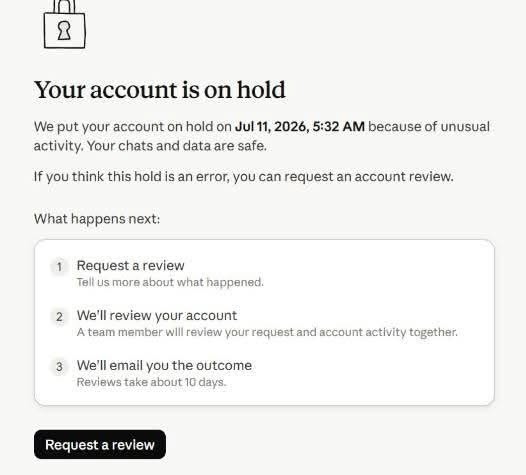
“I use Claude Code for almost everything in my business. I need it back asap.”
Someone posted that in a developer forum this week. Their account had been placed on hold for "unusual activity." No explanation of what triggered it, no phone number to call, just a support ticket sitting in a queue with no ETA.
I've watched enough of these threads pile up to know how the rest of the story goes. It's rarely fraud. It's a fraud-detection model that flagged a pattern, a support team stretched thin, and a business owner who built months of workflow on top of a tool they don't actually control.
That's the part people miss when they pick a closed AI provider because it's the smartest model on the leaderboard that week. You're not signing up for a tool. You're signing a lease, and the landlord can change the locks whenever their risk model tells them to.
Why “unusual activity” locks are a business continuity problem, not a support ticket
Every major AI provider runs automated abuse detection, and for good reason. Scraping, stolen cards, and shared accounts are real problems at their scale. But the same systems that catch fraud also fire on things that look like fraud and aren't: a VPN, a new IP address from a work trip, a credit card that doesn't match your billing country.
When that happens, you don't get a specific reason. You get a templated notice and an appeals process with no visible timeline.
I've seen founders talk about buying a new SIM, switching credit cards, or spinning up a fresh account just to get back into a tool that was running their invoicing, their support macros, or their entire codebase's CI checks. None of that is a plan. It's a workaround you're improvising at 2 a.m. because you never had a fallback.
The other way a rented tool disappears: somebody else's roadmap
Account locks get the panic-post energy, but they're not even the most common way this bites you. The more common way is quieter: the company just stops making the thing you built your workflow on.
OpenAI launched ChatGPT Atlas, a full AI-native browser, in October 2025. In July 2026 it announced Atlas would stop working on August 9, about a month's notice. If your team spent that year building research and task-automation habits into that specific browser, your bookmarks, open tabs, and saved workflows don't come with you.
A “no longer strategic” decision costs them one deprecation email. It costs you a scramble.
Atlas wasn't a bad product. It just stopped being worth the org-chart space once OpenAI decided the same agent features belonged inside ChatGPT and Codex instead. That's the pattern to actually plan around: not that a vendor might act maliciously, but that they answer to a roadmap and a shareholder base that has never heard of your business.
What open source actually buys you here, and where I'd push back on myself
The clean answer is: run open-weight models like Llama or Mistral on your own infrastructure or a dedicated instance, and nobody can flag your account for "unusual activity" because there's no account to flag.
That part's true, and it's why I think any team with AI in a critical path should have at least one open-weight model wired in somewhere. But I'd be lying if I said it's a free upgrade.
Self-hosting trades an account-suspension risk for an infrastructure-ownership job. Someone has to run the GPU box, patch it, and get paged when it falls over at 2 a.m. Open-weight licenses aren't always as unconditional as "open source" implies either.
The free commercial grant ends once you or your affiliates cross 700 million monthly active users, and Meta can update its Acceptable Use Policy without asking you first.
That's a real constraint. It's just a different one than "your account got flagged for no stated reason." The honest version of this pitch isn't "open source has no downsides." It's "the downsides of open source are ones you can see coming and plan for, instead of a locked door with no explanation."
How to actually put this into practice
You don't have to choose between one rented model and one self-hosted model. That's the same single-point-of-failure mistake with a different vendor. Start with whichever workflow would hurt the most if it went dark tomorrow, and give it a second path:
- Pick one open-weight model as a real fallback. Not a toy experiment. Llama 3.3 or the latest Mistral, run through a managed inference API like Together or DeepInfra if you don't want to own hardware yet.
- Write your prompts and tool calls so they aren't glued to one provider's exact API shape. If switching providers means rewriting your integration from scratch, you don't have a fallback, you have a second single point of failure with better branding.
- Test the fallback before you need it. Point your lowest-stakes workflow at the open-weight model for a week and see what breaks.
- Keep your billing boring. Match your card's billing address to where you're actually working from, and skip rotating consumer VPNs for anything tied to a paid AI account. Half of the “unusual activity” locks I hear about are provoked, not random.
None of this means walking away from Claude or GPT-5. They're good tools and I still use them daily. It means treating them like what they are: a vendor you don't control, not a foundation you build an entire business on without a backup plan.
Takeaway
The next account lock, the next deprecation email, the next "we're sunsetting this feature" announcement isn't a matter of if. Build like you already know that.